
Article: 7 Bahamas Crossing Weather Checks Before You Leave Miami
7 Bahamas Crossing Weather Checks Before You Leave Miami
Last Updated: November 4, 2026
Quick Summary
Plan your bahamas crossing weather around a stable window of light to moderate wind blowing with the Gulf Stream, not against it. Check the marine forecast within 48 hours of departure, compare wind, wave height and offshore zones, and delay if winds oppose the current. The Miami to Bimini passage covers about 50 nautical miles.
- Wind blowing against the Gulf Stream builds short, steep seas that are uncomfortable for guests.
- Review the marine forecast several times in the 48 hours before departure.
- Check wave height and offshore Gulf Stream zones, not just the Miami forecast.
- Add a buffer to crossing time for slower speed, wind shifts and a possible hold at entry.
- Set a clear go/no-go decision time with your captain and keep an alternate day.
Table of Contents
- Why the Bahamas Crossing Weather Window Matters More Than Your Departure Time
- Reading the Bahamas Marine Forecast and Sea Conditions
- How Long the Miami to Bimini Yacht Crossing Takes at Realistic Speeds
- Pre-Departure Weather Checklist for Bahamas Yacht Crossings
- Planning Your Bahamas Crossing With YCN Yachts
- Frequently Asked Questions
Why the Bahamas Crossing Weather Window Matters More Than Your Departure Time
Planning a Bahamas crossing from Miami starts with the bahamas crossing weather, not the calendar. A yacht that leaves on a calm morning can still face hard conditions by mid-afternoon if the wind shifts against the Gulf Stream.
The Gulf Stream runs north along the Florida coast and carries warm, fast-moving water across the route to Bimini and Nassau. When strong winds blow against that current, the water builds into short, steep seas. Those seas can make a crossing uncomfortable for guests and demanding for the crew, even on a large vessel.
Here is the practical takeaway: pick a window of stable wind, ideally light to moderate and blowing from a favorable direction, and hold to it. Departing on schedule matters less than departing when conditions support the passage.
Reading the Bahamas Marine Forecast and Sea Conditions
The marine forecast tells you more than a general weather report. Look for wind speed and direction, wave height, and the forecast period, then compare those figures against your planned crossing time (Safeboating Marine Forecast). A forecast that looks calm for Miami may differ offshore, so check the offshore and Gulf Stream zones as well.
Forecasts change quickly, so review them several times in the 48 hours before departure. The National Weather Service Marine forecasts from the National Weather Service marine forecasts for the Florida coast are a reliable starting point for U.S. waters, and the NOAA National Hurricane Center tracks tropical systems that can change a window in hours.
A useful rule of thumb: if the forecast shows winds opposing the current and building seas, delay. Wait for a window where wind and current align or where wind speed drops below the level you are comfortable with. If you are still deciding on timing, our team can help you plan your Bahamas charter with YCN Yachts around a realistic weather window.
Gulf Stream Effects on Wind-Against-Current Seas
When wind blows against the Gulf Stream, the sea state can change quickly. Waves stack up, lose their spacing, and become much steeper than the forecast wave height suggests.
The effect is strongest when the wind is from the northeast or east and the current is running north. Plan a crossing with a wind direction that works with the current, and if that is not possible, build in extra time to wait for a better window. If you are still weighing which vessel suits these conditions, see which yacht types handle a Gulf Stream crossing well.
How Long the Miami to Bimini Yacht Crossing Takes at Realistic Speeds
The Miami to Bimini crossing is roughly 50 nautical miles, and the time it takes depends almost entirely on your cruising speed and the sea state. For a full overview of the route, timing, and entry requirements, read how to sail from Miami to the Bahamas. At a steady cruising speed in calm conditions, most vessels complete the passage in a few hours. Rough seas can add significant time, because captains often slow down for guest comfort.
Plan for the worst case, not the best. Add a buffer to your timetable for slower speed, wind shifts, and a possible hold at the Bahamian entry point. Plan for the time you will spend on the water, not the time on the chart.
Fuel planning also follows from crossing time. Build in a reserve beyond the direct route so you are not forced to make a difficult decision at sea.
Pre-Departure Weather Checklist for Bahamas Yacht Crossings
Use this checklist in the 24 to 48 hours before you leave Miami:
- Review the marine forecast for the Florida coast and Gulf Stream zones
- Confirm wind speed and direction for the full crossing window
- Check wave height and sea state forecasts, not just wind
- Look for any tropical systems or small craft advisories in the area
- Compare forecasts from at least two sources
- Confirm your departure window and an alternate day
- Set a clear go/no-go decision time with your captain
- Verify fuel and provisioning for the crossing plus a reserve
- Brief guests on the expected conditions and seasickness options
- Confirm the Bahamian entry requirements before departure
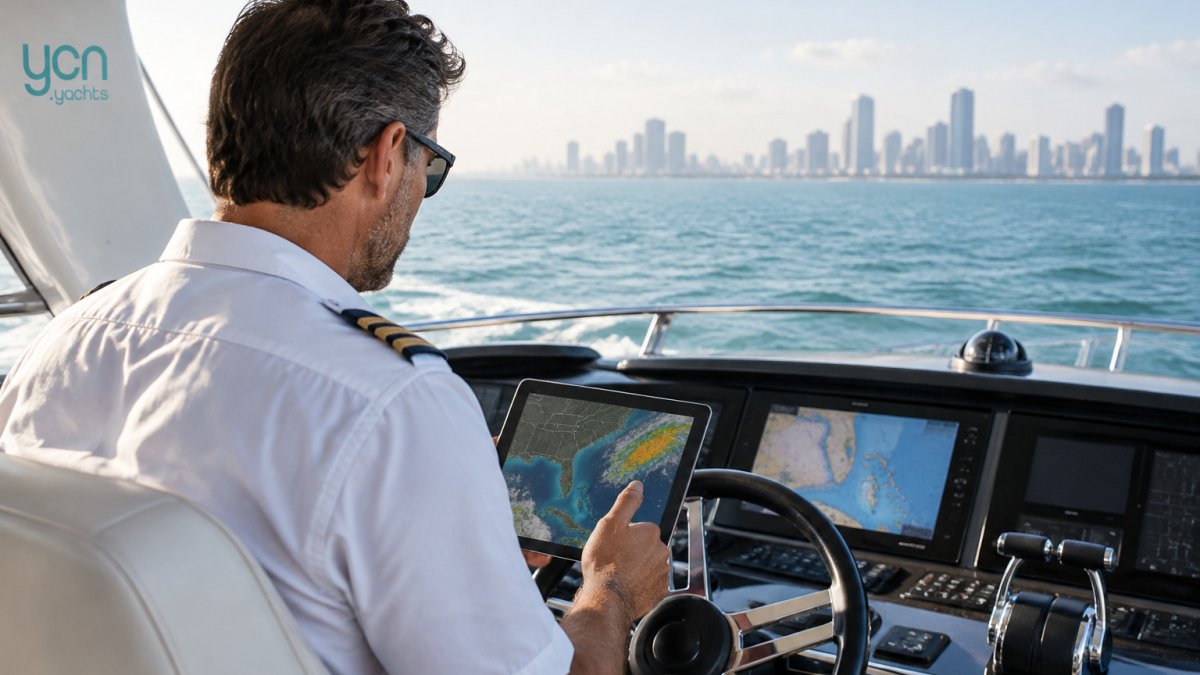
Photo: A captain at the helm of a motor yacht reviews a marine weather app on a tablet while the Miami skyline recedes in morning haze. The captain is American.
Before you leave Miami, these are the key figures and checks to confirm for the crossing.
| Check | Timing | What to confirm |
|---|---|---|
| Marine forecast review | Within 48 hours of departure | Wind speed, direction, wave height |
| Forecast comparison | Before departure | At least two sources |
| Go/no-go decision | Set in advance | Agreed time with your captain |
| Fuel planning | Before departure | Crossing plus a reserve |
| Crossing distance | Planning stage | About 50 nautical miles to Bimini |
Planning Your Bahamas Crossing With YCN Yachts
A well-planned crossing starts with the weather window and ends with a comfortable arrival. At YCN Yachts, we help guests match their dates, their vessel, and their comfort level to the conditions that are realistic for the trip. Our charter specialists can talk through options with you, and if you are planning a route beyond the Bahamas, you can request a private yacht charter quote.
Ready to plan your passage? book a Miami to Bimini yacht charter and our team will help you choose a departure window that fits your schedule.
Frequently Asked Questions
What weather conditions are best for a yacht crossing from Miami to the Bahamas?
Wind opposing the Gulf Stream can build steep, uncomfortable waves quickly, so stable, settled conditions across several forecast cycles matter more than a single good-looking day.
How do you check the marine forecast before crossing to Bimini?
Start with the National Weather Service marine forecasts for the Florida coast. Check wind speed, wind direction and wave height, and review forecasts more than once before departure, because conditions can change quickly.
How long does a yacht crossing from Miami to Bimini take?
A Miami to Bimini crossing is roughly 50 nautical miles across the Gulf Stream. Travel time depends on vessel type, cruising speed, current and sea state, so build in a buffer for arrival formalities in Bimini and plan the return crossing with the same care as the outbound leg.













Laisser un commentaire
Ce site est protégé par hCaptcha, et la Politique de confidentialité et les Conditions de service de hCaptcha s’appliquent.